






Dear Friends and Neighbors,
This year’s regular legislative session will end sometime Thursday — probably well into the evening, if history is any guide. I’m specifying regular because just today I heard rumblings that the majority party may need an overtime period (officially, an extraordinary session) to work on budget-related legislation. I hope that ends up being only a rumor, but we’ll know soon enough.
Lawmakers in the Senate and House of Representatives are focused on two things during our remaining time: “concurrence” and considering legislation that is labeled “necessary to implement the budget” (NTIB).
Here’s concurrence, in a nutshell: A bill can’t become law unless the same wording is approved by both the Senate and House. Therefore, if the House makes changes to a bill passed by the Senate, the bill comes back to the Senate so we can vote on whether to “concur” (agree) with what the House did, or not concur.
Voting to concur concludes the Legislature’s work on a bill and sends it to the governor. If we don’t agree, the bill goes back to the House to decide what its next move will be. Sometimes a bill fails because the two chambers simply can’t get to an agreement, even if they try what’s known as a “conference” to iron out their differences.
Since it originated as a Senate bill but is being changed in the House, the legislation to create a state income tax will come back to us for concurrence tomorrow or Thursday — there’s more on Senate Bill 6436 below.
The Senate majority’s controversial anti-sheriff bill (SB 5974) and anti-mask bill (SB 5855) were on yesterday’s concurrence list. The changes made by the House didn’t make either better, but the majority moved them on through to the governor. These and the approval of legislation expanding the state attorney general’s powers are contributing to the erosion of local control.
Another measure that is controversial but important to our area has to do with immigrant workers and federal I-9 form audits. HB 2105 was changed before the Senate majority passed it March 5, so we’ll see what the House does about that.
The three budgets all were sent to conferences this past week. These are supplemental budgets because they make adjustments to the budgets adopted in 2025. We’ll probably see the final versions tomorrow.
I’ll summarize the supplemental transportation budget and the supplemental capital budget after those are settled. The supplemental operating budget is a different story, because we don’t have to wait for a final version to know the majority side is going for another big spending increase backed by a combination of (more) tax increases and money taken from other accounts. Please keep reading for where that stands.
The proposed income tax was understandably on the minds of many who took part in our recent 12th District virtual town hall. More than 180 people signed up to participate, and because there were so many thoughtful questions we were happy to run past the scheduled ending time.
Whenever you have questions or need help dealing with a state agency, please reach out. My email is keith.goehner@leg.wa.gov and my Senate office phone number is 360-786-7622.
Sincerely,

Keith Goehner, 12th Legislative District
Washington State Senate
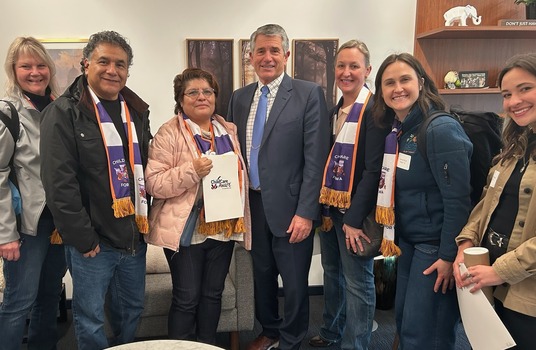
The affordability of and limited access to childcare in our state has come up often this session. I appreciated that this group representing Child Care Aware of Washington made the long trip to the Capitol to be heard.
Income-tax bill will come back to Senate after House vote — as unconstitutional as before
As I write this the House is continuing a marathon debate on the proposed state income tax. It began Monday evening and is fast approaching the 24-hour mark.
The version of Senate Bill 6346 being debated today is significantly different from what the Senate majority approved Feb. 16. For instance, it would greatly expand eligibility for the Working Families Tax Credit to the point that a single filer earning $115,000 would qualify.
Having government collect and redistribute money isn’t the kind of direct tax relief I’d prefer to see. However, it seems to have worked on Governor Ferguson because he endorsed the House approach Friday in spite of an earlier call for more tax relief. For more reaction to the governor’s announcement from others who oppose the income tax, click here.
The version coming from the House still contains the flaws from the original Senate bill. Those include the language that prevents the people from challenging the income tax, if it becomes law, through a voter referendum. Like their counterparts in the Senate, the House majority rejected an amendment to remove that wording.
The refusal to automatically allow a public vote is among the many reasons I oppose SB 6346. What troubles me the most about the proponents of the income tax is that these same people seem to be ignoring the unconstitutionality of the bill — and the clear language in Article VII, Section 1 of our state constitution, put there by the 14th Amendment passed by Washington voters in 1930.
Here it is, with emphasis added:
All taxes shall be uniform upon the same class of property within the territorial limits of the authority levying the tax and shall be levied and collected for public purposes only. The word “property” as used herein shall mean and include everything, whether tangible or intangible, subject to ownership.
The courts and voters have rejected a state income tax at every opportunity over the past 90-plus years. It’s expected that the state Supreme Court will have the final say on this, if the tax is approved, but the precedent is clear. The sponsors of SB 6436 seem to be hoping the current set of justices will do a flip-flop and decide your income is not your property. I can’t support that.
To me, your income is intangible and subject to ownership, and as property, it can’t be taxed at a different rate than anyone else’s. There is no reason to change now.
Budget proposals spend too much, rely on more taxes, don’t help with affordability crisis
The supplemental operating budget approved by the Senate majority would lift spending for this budget cycle to over $80 billion. The House majority took the budget bill (Senate Bill 5998) and increased spending to $80.4 billion.
Based on that, we should expect the final budget that comes before the Senate for a vote later this week will also exceed $80 billion. That’s a problem because the latest state-revenue forecast, from mid-February, anticipates no more than $75.2 billion for the current budget cycle.
Where the approaches differ is on how to make up that multibillion-dollar difference. The Senate majority would pull billions of dollars from one-time sources, including the “rainy-day” account and funds that support public construction and public-works projects. The House majority would do some of that but also tap the largest of the funds that supports pensions for law-enforcement officers and firefighters.
Then there are the additional taxes. Besides the income tax, the majority is advancing other measures that would make Washington even less attractive to employers: Senate Bill 6228, which would raise health-care costs and is bad news for rural pharmacies in particular, and Senate Bill 6231, which would reduce the incentive for tech startups by increasing data-center costs.
To balance, the Senate budget even assumes more than $800 million will go unspent by state agencies, and that the level of spending growth would drop to 2.2%. Those are fantasies, considering spending has grown by 10% or more each cycle since 2018.
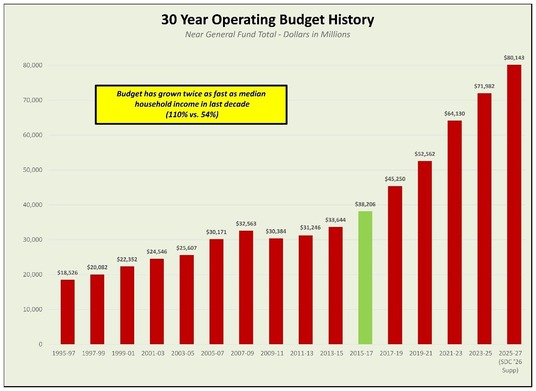
As the chart above shows, state spending has grown much faster than household income since Olympia fell back under one-party control in 2018. The Senate and House budgets would both increase spending by another 11+%.
Our side attempted to save money and reprioritize spending toward things like helping children with the transition to kindergarten, meeting the needs of local school districts, adding front-line workers to Child Protective Services and much more. In all, 19 of our amendments were rejected.
Another of those unsuccessful amendments was mine. It would have added money to monitor and track the progress of permitting new housing to address regional housing supply crises. The amendment would have also restored grant funding to update and implement comprehensive plans at the local level.
Our budget leader called the Senate budget an “$80‑billion house of cards on a shaky foundation of assumptions and short-term fixes.” It’s more proof that Olympia has a spending problem, not a revenue problem. Unfortunately, the final budget is sure to continue that pattern.
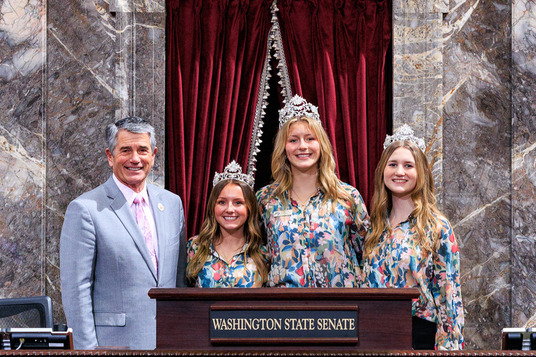
It was my privilege recently to welcome the Apple Blossom Festival’s 2026 Royal Court to the state capitol. From left to right are Princess Parker Averi, Queen Brielle Precht and Princess Kaylee Pearsons. The Senate also approved a resolution honoring their achievements.