







Feb. 18, 2026
Dear Neighbors and Friends,
The Senate yesterday reached what the official session calendar calls “house of origin cutoff.” It was the deadline for bills originating in the Senate to be passed by the Senate. The cutoff applies to the House as well, for action on House bills.
A look at the bills that survived this first major deadline reveals much about the priorities for the session. Bills that didn’t move forward by the close of business are considered “dead” for the rest of the session, with the exception of legislation needed to implement the budgets that must be adopted before we adjourn for the year.
The biggest disappointment of the session so far has to be Monday’s vote to pass legislation that would create a state income tax. Even though this is the most consequential piece of legislation seen in Olympia in generations, the majority party fast-tracked it through two committees and the full Senate in less than two weeks.
The tax, if it becomes law, wouldn’t be collected until 2029 — not in time to help resolve the $1.5 billion shortfall in the state operating budget. The obvious question, then, is why would passing it be such a priority now?
Please keep reading for more about the income-tax proposal and a look at some other notable bills. Also, I hope you’ll set aside an hour this coming Monday evening to take part in our virtual town hall! The details are here.

Whenever you have questions or need help dealing with a state agency, please reach out. My email is keith.goehner@leg.wa.gov and my Senate office phone number is 360-786-7954.
Sincerely,

Keith Goehner, 12th Legislative District
Washington State Senate
Income-tax bill is unconstitutional, unpopular and unnecessary… but it was passed anyway
If social media posts are anything to go by, some people are convinced that the income-tax bill passed Monday by the Senate — which is purposely titled a “tax on millionaires” — would never apply to them. The trouble is, that $1 million limit is found in a single sentence in a single section of the bill. It would be a simple matter for future legislators to change a few words and make the tax apply to a much lower income level.
When the bill was in committee, the prime sponsor was asked to clarify the intent of his bill. He declined to commit to permanently restricting the tax to incomes above $1 million. Future lawmakers should have “flexibility,” he said. I know what that means.
Whether it becomes law or not, the state income-tax proposal is the most controversial bill we will see this session. I’m opposed to it for several reasons, starting with the fact that I took an oath to uphold both the U.S. and Washington constitutions — and the approach Senate Bill 6346 takes to an income tax seems to clearly go against the limitations on taxes in our state constitution.
The income-tax bill also is by far the most unpopular bill seen in the Senate. I say that because after the Senate Ways and Means Committee scheduled a hearing on SB 6346, some 80,000 people went online to register their support or opposition — a record — and of those, more than 61,000 people signed in as opposed, which is also a record.
In addition, this tax is unnecessary. The people send more than enough money to Olympia as it is, yet the income tax being proposed would become the biggest tax in the state, at an estimated $3.5 billion per year. To be fair, SB 6346 does provide for a small amount of tax relief, but it’s an embarrassingly small amount — indicating this is more of a money grab by the state than a sincere effort to make Washington’s tax code fairer.
The supporters see this tax as so necessary that they included wording in the bill to prevent the people from overturning the tax (if it becomes law) through a voter referendum. Why be afraid to let the people have the final say?
Many of us believe the income tax is being pushed here in 2026, even though it wouldn’t be collected until 2029, because the supporters know it will be challenged one way or another — just not through a referendum. That leaves a lawsuit or a citizen initiative, both of which are more complicated than a referendum would be.
Those of us who think there should be a public vote on a state income tax tried to get there with two amendments to the bill. Both were rejected.
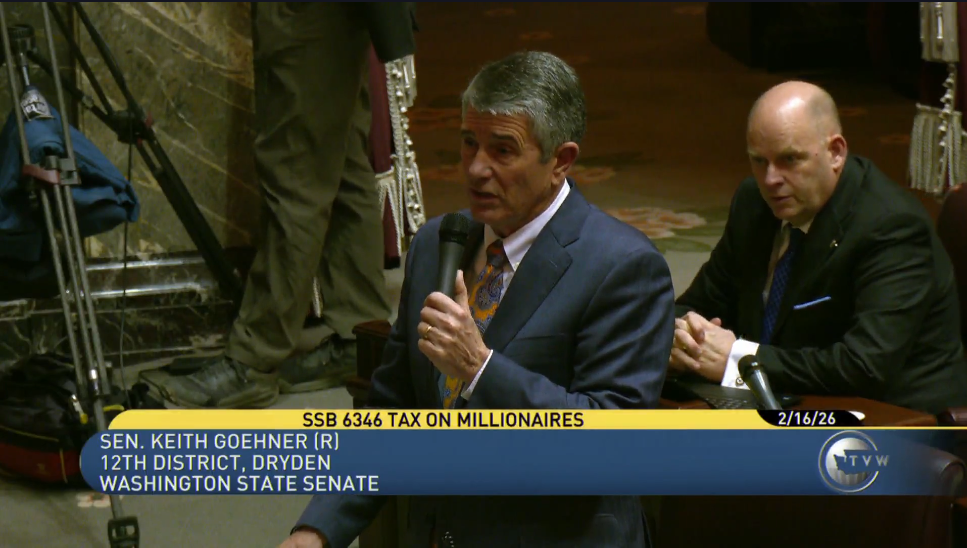
SB 6346 has been transmitted to the House. It’s expected to pass there as well, but if any changes are made along the way, the bill will have to come back to the Senate for another vote. I’ll keep you posted. Click here or on the image below for the remarks I made prior to the vote; they include other reasons I oppose the income tax.
Anti-agriculture, ‘initiative killer’ bills fall short
In recognition of the Presidents Day holiday earlier this week (which was not a holiday for legislators, but that’s a different story), let me quote President Calvin Coolidge, before he was in the White House. As a Massachusetts state representative in 1910, he wrote his father that it is “much more important to kill bad bills than to pass good ones.”
Stopping bad bills means fewer bad laws, and a less intrusive government. Of the many bills that failed to survive yesterday’s house-of-origin cutoff, I’ll point to a couple that have attracted a lot of public attention: Senate Bill 6045 and Senate Bill 5973.
SB 6045 would allow collective bargaining for agricultural workers. It’s a bad idea, because farmers and growers are having enough trouble already with all the other costs that are increasing for Washington agriculture. Can you imagine workers going on strike at harvest time, especially when the 2025 session produced a law allowing striking employees to collect unemployment benefits while they’re picketing?
SB 5973, which became known as the “initiative killer” bill, is clearly meant to discourage people from exercising their constitutional power of initiative and referendum. It would force initiative sponsors to do two rounds of signature-gathering, not just one, not just one, and also make signature-gatherers liable for penalties up to $10,000 if it can be shown they were compensated based on the number of signatures they collected.
I have to point out that no bill is truly “dead” until the Legislature adjourns, so it’s too soon to celebrate — but the fact that these failed to advance before the cutoff is encouraging, to say the least.
Of the 200-plus Senate bills that were passed and sent over to the House, the most controversial so far — next to the income tax — is likely Senate Bill 5974. This became known as the “anti-sheriff” bill because it would effectively let an unaccountable state commission remove an elected sheriff, which amounts to overruling the will of the voters. I don’t stand up to speak on every bill that comes before the full Senate for a vote, but I feel strongly about this legislation — click here to view my remarks opposing SB 5974.
Other examples of Senate bills that passed in spite of my concerns include:
- Senate Bill 5993: This would limit the interest on medical debt to 1% starting in 2027. I and other opponents see this as treating medical debt like a low-interest loan; our concern is that hospitals, especially in rural areas, won’t be able to afford this on top of the charity care they already provide.
- Senate Bill 5177: For the second straight year the Senate majority passed this, to add even more topics — like religion, national origin and immigration status — to the list used in professional development training for staff at our public schools. When this bill came to the K-12 committee, someone opposed the bill on the grounds that social issues are being overemphasized in our schools at the expense of educational outcomes.That captures my feelings as well. The House didn’t pass the bill in 2025; we’ll see if it changes its position this year.
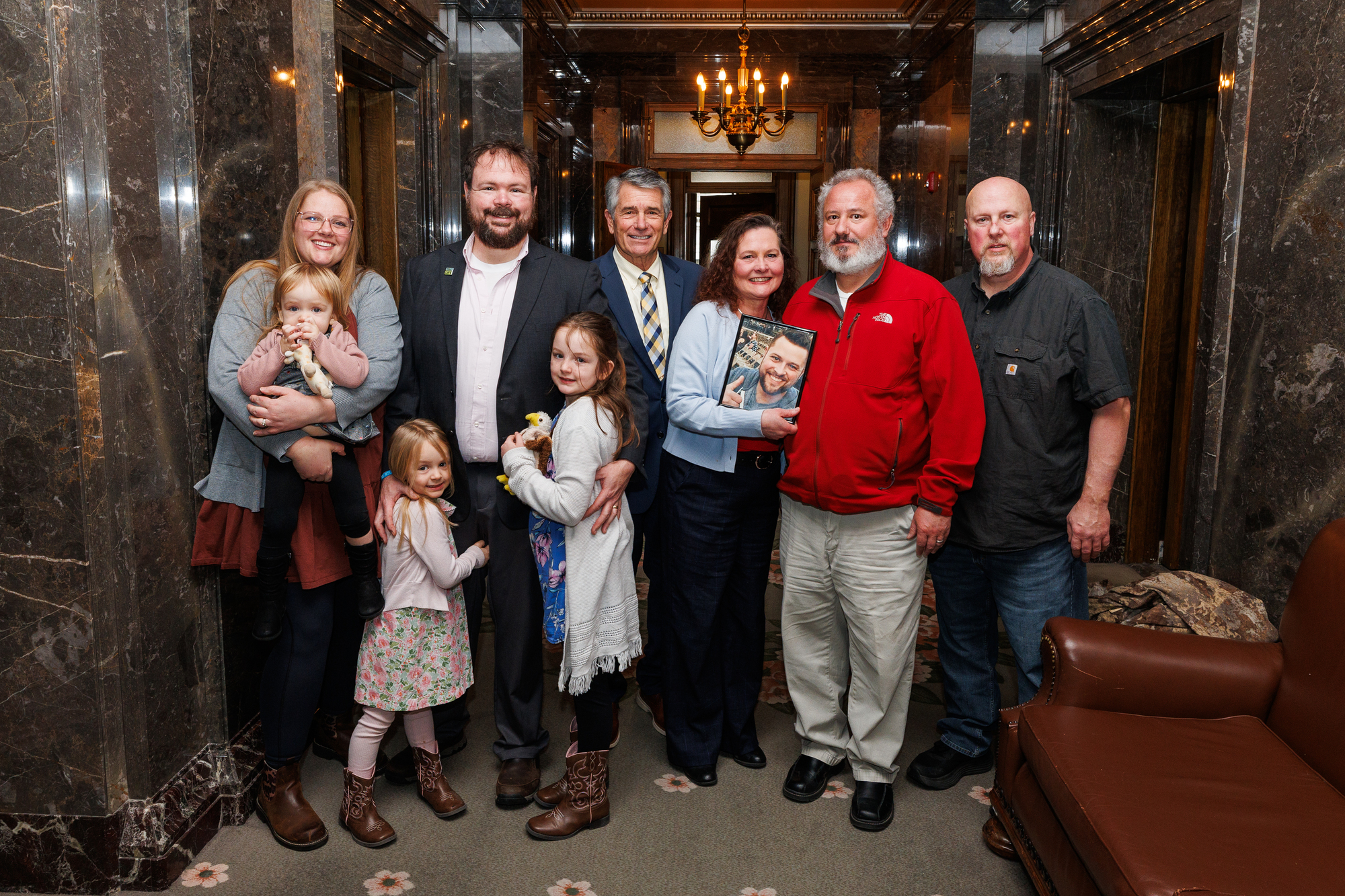
It was my honor to again sponsor the annual Senate resolution designating April as National Donate Life Month in our state. Many Washington residents have literally given the gift of life by donating organs, eyes, and tissues; one of the recipients is Brandt Cappell, who became chief deputy auditor for Chelan County in 2025 after many years as my longtime legislative assistant. That’s Brandt and his family (Brittney, Savannah, Cassidy, and Katy) to the left of me in the photo; at right are immediate family members of the young man whose untimely death enabled a heart transplant for Brandt. They were all present for the passage of this very important resolution.
Budget update: Even more tax increases?
Olympia employs a chief economist whose job includes developing quarterly forecasts of the revenue coming in through the many taxes imposed in our state. The first revenue forecast of each year is of particular interest to the legislative budget writers, so they know what they have to work with.
The first forecast for 2026 was released Monday. It came in about $825 million higher than expected, which is good news for two reasons. First, that much revenue is enough to offset more than half of the estimated $1.5 billion deficit in the state operating budget. Second, the positive forecast suggests the impact of federal tariffs on our economy has not been as severe as some predicted.
That still leaves a gap of many hundreds of millions of dollars to fill, however. The better approach would be to go through the budget carefully to identify savings and efficiencies. The majority seems to be looking to address the remaining shortfall through more taxes, unfortunately.
Tomorrow the Senate Ways and Means Committee is scheduled to consider a set of seven tax or fee increases totaling about $1 billion per year. They include:
- SB 6231, which would raise taxes on data centers and make Washington less competitive for investment and job growth.
- SB 6129, to increase the cigarette tax to $5 per pack.
- SB 6173, which is the largest proposal in the set. It would create a new employer tax to fund Medicaid, at an estimated cost of $800 million annually.
The list also includes a bill to raise the retail bag fee to 11 cents, from the current 8 cents.
Because these bills are tied to the budget, they aren’t subject to the same deadlines as other legislation. I don’t think any of these are the right answer, though — to say it again, you don’t make our state more affordable by making things more expensive.
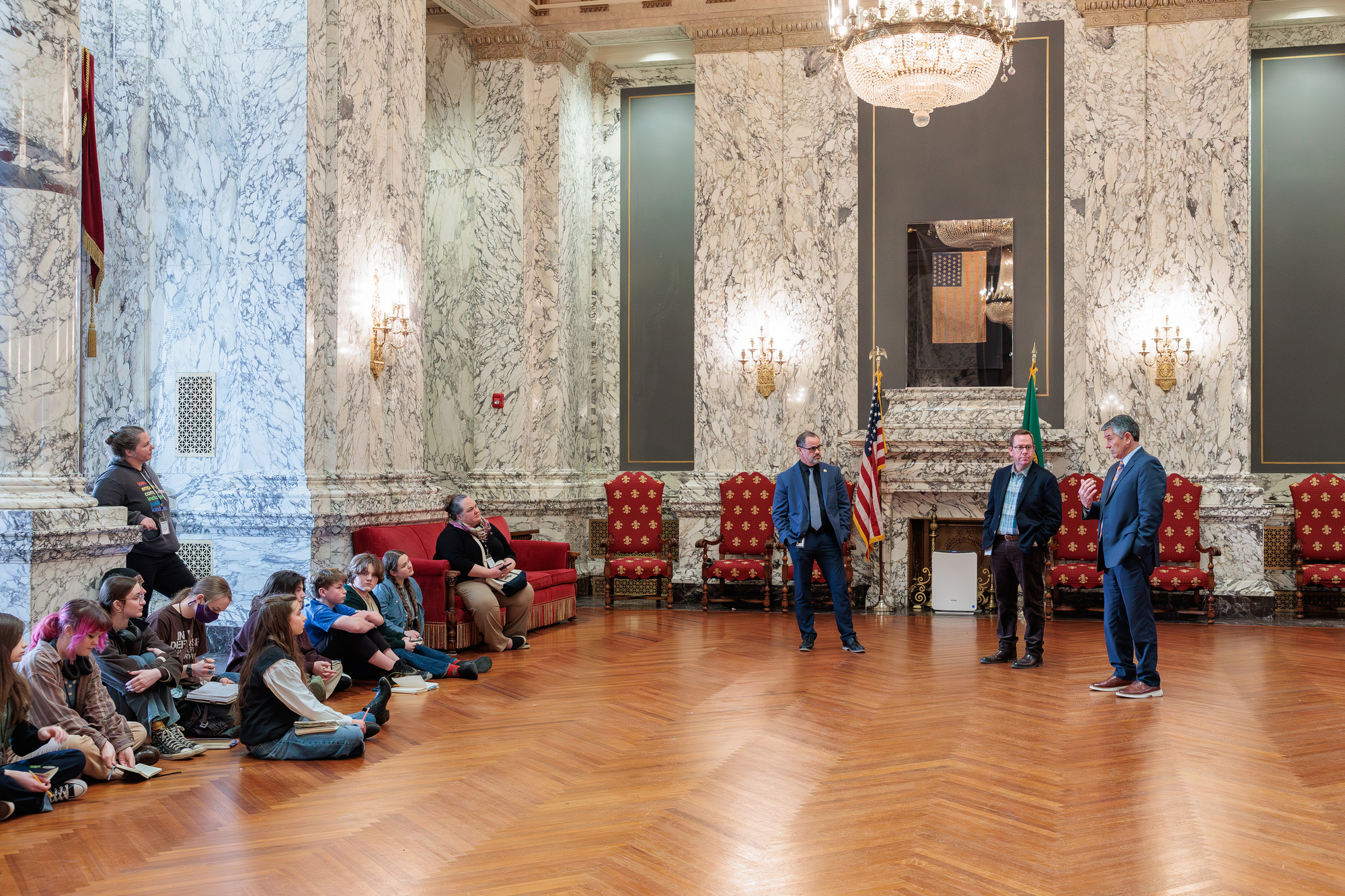
I enjoy seeing visitors from our legislative district, and when it’s a larger group the State Reception Room in the Legislative Building is a great place to meet. It was my pleasure to join Rep. Steele and Rep. Burnett there recently when students from Monroe Sky Valley Education Center traveled to the Capitol.